
K-12 CS for Learners with Disabilities Microcredential
Your introduction to reaching the widest range of learners in CS education
About our approach
How do you teach computer science when your students have vastly different needs? This microcredential course provides a basic toolkit for building an accessible computer science curriculum for K-12 classrooms.
Many teachers feel overwhelmed by the range of needs in their classrooms and the lack of specific support for CS education. You might know general Universal Design for Learning (UDL) strategies for reading or math, but applying them to coding can be time-consuming.
Our course bridges that gap. We teach you how to build a proactive, sustainable, and accessible computer science curriculum that works for your specific students
By the end of this course, you will move from simply accommodating students to empowering them. You will learn to keep the curriculum consistent for all students while offering varied entry points for engagement. You will learn to design flexible assessments where students can prove their computational thinking in the way that works best for them—whether through blocks, text, verbal explanations or physical manipulatives.
Microcredential Overview
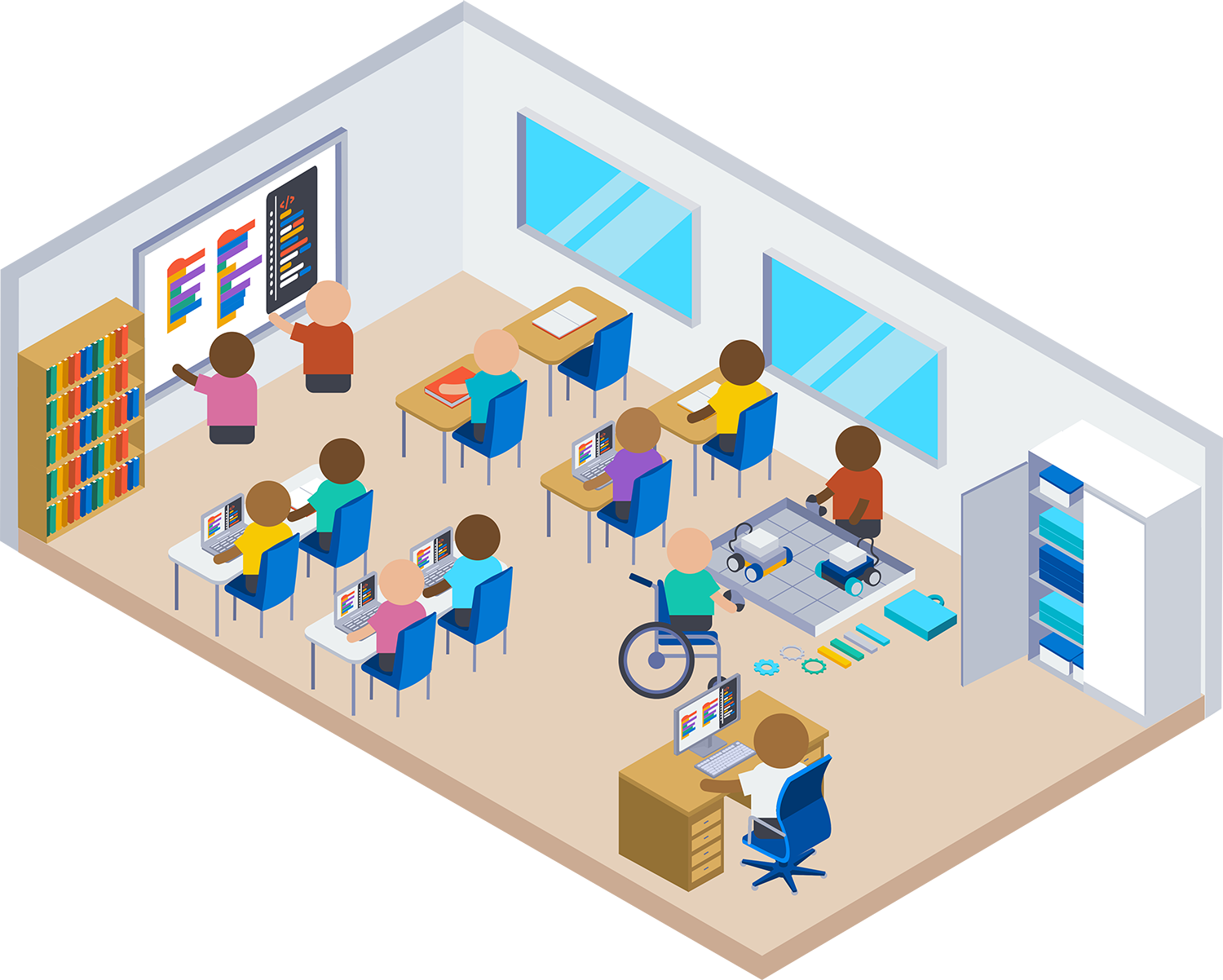
This microcredential course provides a basic toolkit for reaching the widest range of learners, including learners with disabilities, in K-12 computer science (CS) classrooms. The course and activities prepare educators, administrators, and instructional coaches to:
- Apply the Universal Design for Learning (UDL) strategies in computer science instruction
- Identify practices to modify and accommodate learners based on real-word scenarios
- Engage in hands-on activities with accessible coding environments
Program Interest Form
Enrollment is currently closed.
Fill out this program interest form to receive updates and be contacted with more information about our programming.
Benefits
- Earn 20 in-service hours/2.0 CEUs
- Eligible to apply in-service points towards Florida Educator Certificate renewal requirements in teaching students with disabilities
- Earn a Credly Badge of completion to verify digital credentialing
Eligible Participants
The courses in the K-12 CS for Learners with Disabilities track are for everyone. Whether you are an experienced special education teacher or new to supporting learners with disabilities, this course provides you with the tools to reach the widest range of learners in CS classrooms. We recommend this microcredential for the following types of participants:
- General Education Teachers
- Computer Science Teachers
- Special Education Teachers
- Paraprofessionals / Paraeducators
- Preservice Teachers
- Administrators (school and district level)
Time commitment
- Asynchronous and online with a 4-week completion window
- Approximately 20 hours total time commitment
Tuition & Scholarships
- Course tuition: $60 per person
- Scholarships available! Fill out the Program Interest Form for more information on scholarship availability.
Thanks to the generous support of Google.org, we’re able to offer a limited number of full scholarships for teachers and districts.
Course Schedule
Schedule coming soon.
Fill out this program interest form to receive updates and be contacted with more information about our programming.
Learn and Apply our Accessible Computer Science Curriculum
This course translates high-level theory into Monday-ready class strategies.
Participants Learn and Practice:
Interactive Engagement
Engage in self-reflections, quizzes, and peer discussions to deepen conceptual understanding.
Scenario Analysis
Analyze real-world classroom scenarios and case studies to identify hidden barriers to learning.
Curriculum Evaluation
Practice evaluating existing CS curricula by applying UDL and HLP frameworks.
Specific Pedagogies
Experiment with specific CS strategies such as debugging, TIPP&SEE and creating multiple entry points for instruction.
Teachers Finish With:
Redesigned Learning Experiences
A set of CS activities proactively redesigned using UDL principles, featuring built-in scaffolds for engagement and representation.
Scenario Analysis
Analyze real-world classroom scenarios and case studies to identify hidden barriers to learning.
Curriculum Evaluation
Practice evaluating existing CS curricula by applying UDL and HLP frameworks.
Why trust CS Everyone
This course, and our entire accessible computer science curriculum series, was developed by University of Florida researchers and refined through teacher feedback.
By Teachers, For Teachers
Our team includes former classroom CS and special education teachers with deep expertise in UDL, HLP, and accessibility.
Standards Aligned
Every course is aligned with the Computer Science Teachers Association (CSTA) K–12 Computer Science Standards.
